
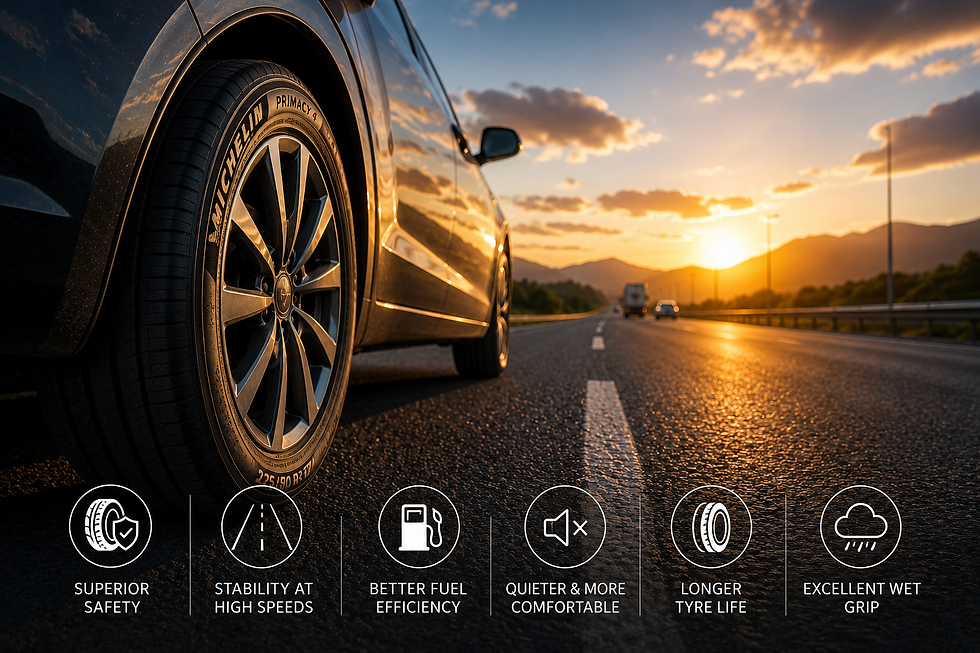
Best Tyres for Long Highway Drives — What Nobody Tells You
A few years ago, I drove from Mumbai to Goa using a set of premium Michelin tyres. The ride was smooth, quiet, and comfortable. Each tyre cost nearly ₹18,000.
A friend made the same trip around the same time using Apollo tyres that cost less than half as much. His ride was slightly noisier, but both of us reached safely, both sets of tyres performed well on the highway, and both lasted for years.
That experience raised an important question.
If both tyres performed similarly, why did one cost nearly double the other?
The answer reveals something many buyers never hear when shopping for tyres.
The Dealer Pitch:
Most premium tyre recommendations follow a familiar pattern. Buyers are told that international brands provide the best grip, the highest safety standards, and the most reliable highway performance.
While premium brands certainly produce excellent tyres, the idea that expensive automatically means safer is misleading.
A quality tyre should be evaluated by its actual performance characteristics rather than its marketing budget.
What Actually Matters for Highway Tyres:
For long-distance highway driving, several factors have a direct impact on safety and performance.
Grip remains one of the most important characteristics because it determines how effectively a tyre maintains traction on wet and dry roads.
Strong sidewalls help protect against potholes and road imperfections, especially on Indian highways where road quality can vary significantly.
Tread depth plays a major role in maintaining grip and water evacuation during rain. As tyres wear down, their ability to perform safely decreases regardless of brand.
Rolling resistance may have a minor influence on fuel efficiency, but its impact is often much smaller than many marketing claims suggest.
In practical terms, a well-maintained mid-range tyre with healthy tread depth can easily outperform an expensive premium tyre that is worn out or poorly maintained.
What Does NOT Matter:
Many buyers place too much importance on brand reputation alone.
Marketing campaigns often create the impression that certain tyre brands are dramatically safer than others. In reality, tyre performance varies significantly between individual models and tread designs, even within the same brand.
Fuel-efficiency claims can also be misleading. While some tyres may provide small improvements in efficiency, the actual savings over a year are often far less than the additional amount spent purchasing premium tyres.
A tyre should be judged by its real-world performance, not simply by its logo.
Indian Road Reality:
Indian highways present unique challenges that tyres must handle every day.
Potholes, uneven road surfaces, loose gravel, high temperatures, and heavy commercial traffic all place stress on tyres. These conditions affect tyre life far more than many drivers realize.
Fortunately, several manufacturers produce tyres capable of handling these conditions effectively. Brands such as Apollo, CEAT, MRF, JK, Bridgestone, and Michelin all offer products suitable for highway driving when chosen correctly.
For most drivers, excellent highway performance can be achieved without spending at the highest end of the market.
What ACTUALLY Determines Safety on Highways:
Many drivers focus on tyre brands while overlooking factors that have a much greater impact on safety.
Correct tyre pressure is critical and should be checked regularly. Improper inflation affects grip, braking, comfort, and tyre life.
Tread depth should be monitored throughout the tyre's lifespan because worn tyres dramatically reduce wet-weather performance.
Regular tyre rotation helps ensure even wear and can significantly extend tyre life.
Proper wheel alignment and balancing improve handling stability and reduce uneven wear patterns.
These maintenance habits often have a greater effect on safety
than the choice between two reputable tyre brands.
The Verdict:
What are the best tyres for long highway drives?
For most Indian drivers, the ideal balance of performance, durability, and value can be found within the ₹8,000 to ₹12,000 price range per tyre.
Premium tyres may offer additional refinement and comfort, but they do not automatically make a vehicle significantly safer.
Unknown or unverified tyre brands should be avoided, as should tyres that have been sitting in storage for many years.
The most important lesson is simple.
Good maintenance, correct tyre pressure, proper rotation schedules, and timely replacement contribute far more to highway safety than paying extra for a premium brand name.
The safest tyre is not necessarily the most expensive one. It is the one that is properly maintained and suited to your driving conditions.