
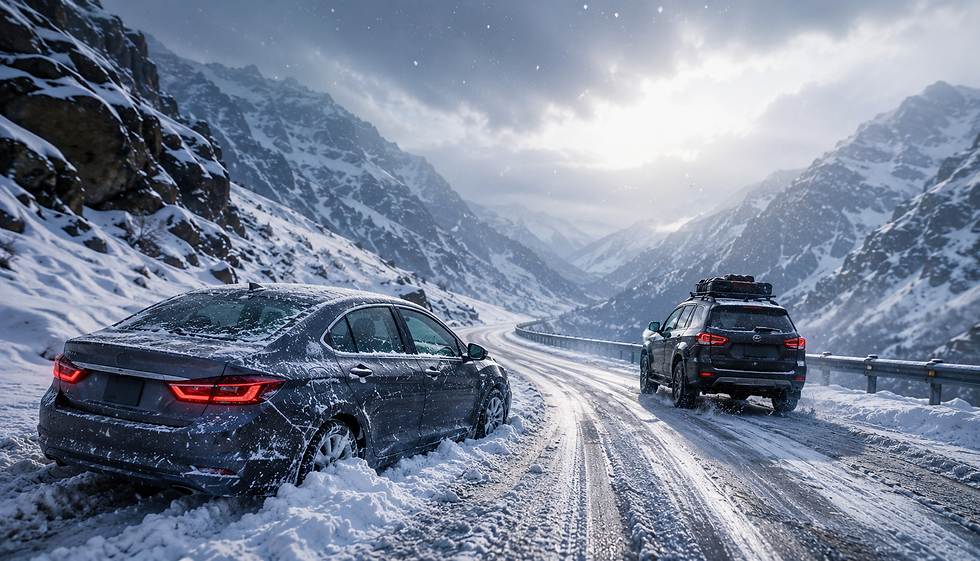
Can Your FWD Car Handle Spiti in Winter? The Honest Answer
A colleague of mine purchased a Honda City and soon planned a winter road trip to Spiti. His reasoning seemed simple enough: modern cars are advanced, and a Front-Wheel Drive vehicle should be capable of handling most road conditions.
Three days into the journey, while driving near Kaza at an altitude of nearly 4,000 meters, heavy snowfall covered the roads. On what appeared to be a relatively mild uphill section, the vehicle lost traction and became stuck. Meanwhile, an SUV equipped with a more capable drivetrain continued without difficulty.
After returning from the trip, he asked a question many drivers never consider before heading into extreme winter conditions:
Why does a FWD car perform perfectly during monsoon rains but struggle so much in snow and ice?
The answer lies in understanding what actually changes when temperatures drop and roads become covered with snow and ice.
The Dealer Promise:
Many people are told that modern FWD vehicles can handle all weather conditions, including rain, snow, and muddy terrain. Technically, this statement is not entirely incorrect.
However, there is a significant difference between driving on a wet asphalt road during the monsoon and driving on frozen mountain roads at high altitude.
A vehicle that performs perfectly in one environment may face serious limitations in the other.
What Changes in Extreme Cold and Snow:
During normal rainy conditions, the road surface remains asphalt. Tire rubber stays flexible, temperatures remain moderate, and vehicles can still generate sufficient grip.
Winter conditions in Spiti are very different.
Roads are often covered with packed snow or ice. Temperatures can drop well below freezing, causing tire rubber to harden and lose flexibility. At high altitude, thinner air can also affect vehicle performance.
Most importantly, the available grip between the tires and the road becomes dramatically lower than what drivers experience during normal driving conditions.
This reduction in grip changes everything.
The Physics Nobody Explains:
Many drivers assume that traction while accelerating is the most important factor in difficult road conditions.
In reality, snow and ice create a different challenge.
The biggest concern is not accelerating. It is maintaining control while braking and steering.
When a vehicle travels across an icy surface, all four tires are competing for the same limited grip. Regardless of whether the vehicle is FWD or AWD, braking performance depends on tire traction.
Similarly, when navigating corners on icy roads, vehicle balance, tire quality, and driver inputs often matter more than which wheels receive engine power.
The road surface itself becomes the limiting factor.
Indian Road Reality:
Many people imagine winter roads in Spiti as roads covered with soft snow.
In reality, repeated traffic often compresses snow into hard ice, creating extremely slippery surfaces commonly referred to as black ice.
A FWD vehicle can generally handle:
-
Snow-covered asphalt with adequate grip
-
Light muddy terrain
-
Fresh snow under controlled conditions
However, black ice presents a completely different challenge.
Once roads become heavily compacted and frozen, maintaining traction becomes difficult for almost every type of vehicle.
Even AWD vehicles can struggle when the surface offers very little grip.
What Actually Matters in Spiti Winter:
When driving in extreme winter conditions, drivetrain choice is only one small part of the equation.
Far more important factors include tire selection, driver experience, road awareness, and vehicle preparation.
Winter tires provide dramatically better grip on snow and ice compared to standard all-season tires.
Drivers with previous experience on icy roads are also far more likely to maintain control in difficult situations.
Ground clearance becomes useful when roads contain deep snow drifts, while specialized four-wheel-drive
systems can offer additional capability in severe off-road conditions.
In many situations, a well-prepared FWD vehicle equipped with proper winter tires
can outperform a poorly prepared four-wheel-drive vehicle.
The Verdict:
Can a FWD car handle Spiti in winter?
Technically, yes.
However, success depends far more on preparation than drivetrain configuration.
Drivers should avoid attempting the journey if they lack winter tires, have no experience driving on icy roads, or are travelling alone without proper support.
A FWD vehicle can complete the trip successfully when equipped with suitable tires, driven carefully, and operated by someone who understands winter driving conditions.
The most important lesson is simple:
Your tire choice matters far more than the difference between FWD and AWD.
For most winter journeys, the right tires and an experienced driver will have a greater impact on safety and confidence than the drivetrain itself.